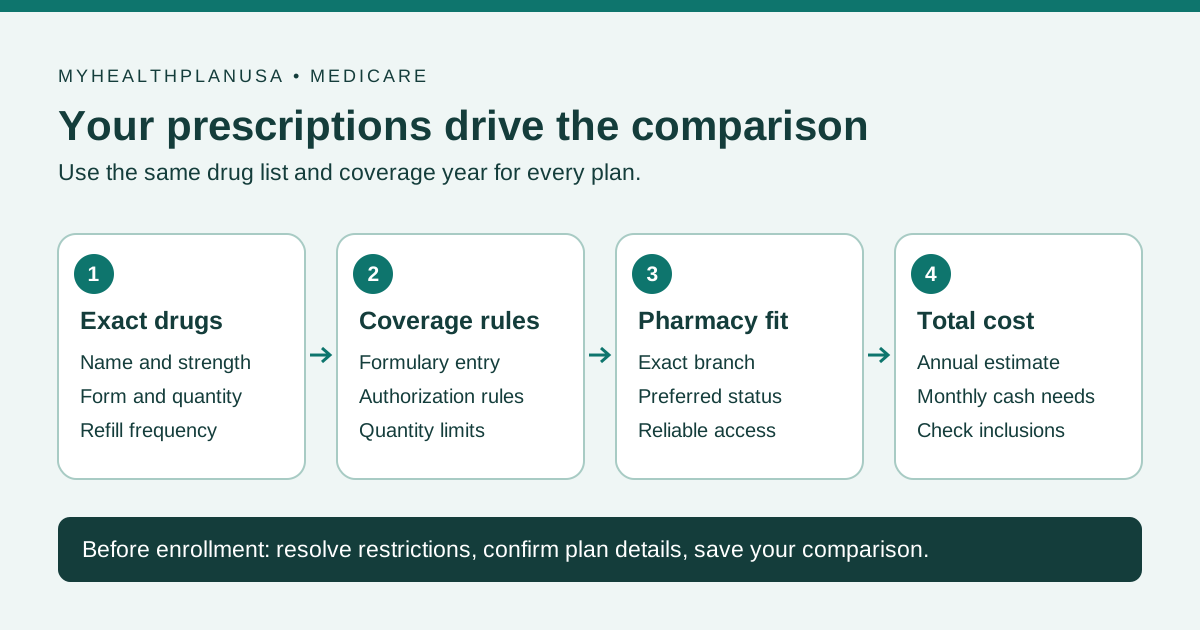
The most useful Part D comparison starts with your prescriptions, not an insurer's name. Two people living at the same address can reasonably choose different plans because their medicines, doses, and pharmacies differ. Build one accurate medication list, run it against the available plans for the coverage year, and then verify the most promising options directly.
This guide provides a repeatable comparison method rather than a national best-plan ranking. Source checks on November 2, 2026 found current 2027 plan information and benefit limits; the example below is fictional and is not a quote. Medicare's official comparison tools let you enter prescriptions and estimate monthly and yearly costs for plans in your area.
First identify the coverage you are comparing
Write down whether you are shopping for a stand-alone prescription drug plan alongside Original Medicare or evaluating drug coverage inside a Medicare Advantage plan. A favorable prescription estimate is only one part of the second decision. Your medical coverage, clinicians, hospitals, and enrollment consequences also need review. Our Medicare Advantage versus Medigap guide explains the broader coverage choice.
Keep your existing coverage card, latest renewal notice, and desired effective date together. Before submitting an application, ask Medicare or the current plan how that enrollment would affect your existing arrangement. This is particularly useful when you receive employer or retiree benefits and cannot evaluate the consequences from a drug-cost screen alone.
Create a medication list precise enough to compare
For every prescription, record the name, strength, dosage form, quantity per fill, and refill frequency. A tablet and extended-release tablet should not be treated as interchangeable search entries. Include regularly used medicines and intermittent prescriptions you reasonably expect to need. Ask your pharmacist to help reconcile old bottles with your current prescription record if the list is confusing.
Add your preferred pharmacy's exact location and one realistic alternative. Note whether home delivery would work for you, whether you need easy pickup after office hours, and whether someone else collects your medication. A cheaper pharmacy that you cannot reach reliably is not an adequate access solution.
Record uncertainties separately. For example, write “prescriber may change this medication after December appointment” rather than silently deleting it. You can run a second comparison later with the revised regimen. Do not stop a medicine or select a substitute simply to improve an insurance estimate.
Check coverage and restrictions before ranking prices
A formulary is the plan's list of covered drugs. Each plan has its own list, so a familiar insurer name does not establish that your prescription is included in a particular product. Check the exact medication entry and plan year. Medicare explains this distinction in its drug coverage overview.
Next, record any restriction next to the drug. Prior authorization requires approval under the plan's rules. Step therapy may require trying another medicine first. A quantity limit restricts the amount covered over a period. A listing marked “covered” therefore does not answer every access question. Medicare's drug plan rules explain these requirements and how a prescriber can support an exception request.
For a medication with a restriction, ask the plan what documentation is needed and discuss it with the prescriber before changing coverage. Record whether you have received an explanation or an actual coverage decision; those are different things. A possible transition supply is temporary help while a problem is addressed, not proof of continuing approval.
Treat the pharmacy as part of the plan choice
Compare each shortlisted plan at the pharmacies you can actually use. A pharmacy can be in the network without being a preferred pharmacy. Preferred network pharmacies may offer lower member costs, while out-of-network purchases can leave you paying the full amount and seeking any available reimbursement afterward. These distinctions come from Medicare's pharmacy guidance.
Build a small matrix with one row per plan and columns for your usual pharmacy, the alternative, and mail order if relevant. Keep refill quantities consistent. Comparing a thirty-day supply in one column with a ninety-day supply in another can make a price difference look larger or smaller than it is. Ask how an urgent replacement prescription would be handled when delivery is delayed or you are away from home.
Compare annual expense and the difficult months
For 2027, Medicare lists a maximum drug-plan deductible of $700 and a $2,400 out-of-pocket threshold for covered Part D drugs, after which covered Part D drugs have no further out-of-pocket charge for the calendar year. Some plans have lower deductibles. These figures are coverage-year specific; they are not a promise that every health expense or premium is capped. See Medicare's current Part D costs.
Use the plan tool's annual estimate and examine its monthly breakdown. Check what the displayed total includes before adding anything. If a yearly figure already includes premiums or the deductible, adding them again would overstate the expense. For a refresher on the cost terms, see deductibles, copays, and coinsurance.
The following arithmetic is an original teaching example for a fictional five-drug list. These are invented annual estimates for three unnamed plans, with identical medicines and refill assumptions. They do not describe actual 2027 offerings or predict your spending.
| Fictional option | Monthly premium | Annual premiums | Estimated annual drug spending at Pharmacy A | Combined annual estimate |
|---|---|---|---|---|
| Plan One | $10 | $120 | $1,300 | $1,420 |
| Plan Two | $30 | $360 | $700 | $1,060 |
| Plan Three | $50 | $600 | $600 | $1,200 |
Plan Two is $360 cheaper than Plan One in this illustration despite its higher premium. Now suppose the same fictional drug-spending estimates at Pharmacy B are $900, $850, and $620 respectively. The combined totals become $1,020, $1,210, and $1,220. The lowest estimate changes to Plan One. This is why the pharmacy comparison belongs inside the calculation.
Neither table settles the decision. If the apparent winner has unresolved authorization requirements, mark it “pending verification.” Also identify the largest expected monthly expense and decide whether you can pay it when due. An affordable annual total can still create a difficult first refill.
Separate payment timing from actual savings
The voluntary Medicare Prescription Payment Plan spreads covered drug out-of-pocket costs across the calendar year. It does not lower those costs. If you participate, you still pay any plan premium and receive drug-cost bills from the plan instead of paying those covered costs at the pharmacy. Ask the plan how bills could change as additional prescriptions are filled.
If the issue is that the total expense is unaffordable, check eligibility for Extra Help or other assistance using Medicare's tools. A payment schedule and an assistance program answer different questions. Include any confirmed assistance in your comparison, but do not assume approval merely because an estimate looks favorable.
Verify the shortlist and preserve the comparison
Before enrolling, save the plan name, identifier, coverage year, comparison date, pharmacy address, medication list, and cost assumptions. For each finalist, ask the plan to confirm the following:
- Whether each exact drug is on the formulary and whether restrictions apply.
- Which pharmacy location is preferred and how mail-order pricing compares.
- Whether the annual estimate includes all premiums and expected covered-drug spending.
- What happens to existing coverage and when the new coverage would begin.
- Where to obtain the current formulary and coverage documents for later reference.
CMS published its 2027 plan landscape announcement, but national averages do not determine the cost of your local plan or medicine list. Recheck the shortlist close to enrollment and retain confirmation details.
Use the Medicare enrollment calendar to identify the window that applies to you. Then transfer the final candidates into a comparison sheet, keeping unresolved items visible. Our general health-plan comparison method offers a broader framework for weighing cost against practical access. A completed comparison should show why the chosen plan fits your prescriptions, pharmacy needs, and budget, not just that its advertised premium is low.
Sources
Frequently asked questions
Is the lowest-premium Part D plan the cheapest?
Not necessarily. Compare estimated annual premiums and drug spending for the same prescriptions and pharmacies, then check restrictions and monthly affordability.
Does a covered drug always have unrestricted access?
No. A formulary listing may come with prior authorization, step therapy, or quantity limits. Check the exact strength and dosage form with the plan.
Can changing pharmacies affect my drug costs?
Yes. Preferred in-network pharmacies can have lower cost sharing than other network pharmacies. Check the specific branch, plan, and year.
Does the Medicare Prescription Payment Plan reduce what I owe?
No. It spreads covered Part D out-of-pocket costs across the calendar year. It is a voluntary payment option, not a discount.