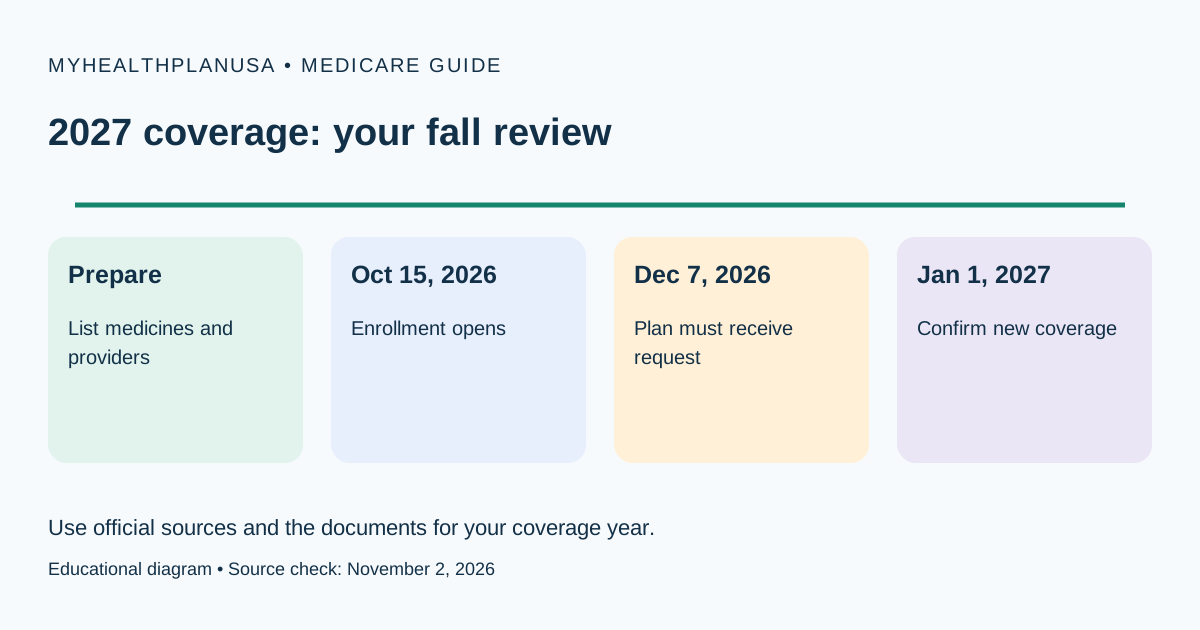
Medicare Open Enrollment for coverage beginning January 1, 2027 runs from October 15 through December 7, 2026. The date in a plan's coverage year is different from the year in which you submit the fall election. If you mean enrollment during fall 2027, that annual window generally selects coverage for January 2028.
This guide is for people reviewing existing Medicare health or prescription coverage. It is not a first-time Part A or Part B enrollment application. The Medicare Open Enrollment page confirms the annual dates, available changes, and requirement that the plan receive your request by December 7.
Start with the decision you actually need to make
Write down your current coverage before comparing advertisements: Original Medicare with a separate drug plan, Medicare Advantage with drug coverage, or another arrangement such as retiree coverage. Include any supplemental policy. A stack of insurance cards can obscure which organization pays which bill.
Your fall decision may be to retain your current plan, choose another health or drug plan, or change between Original Medicare and Medicare Advantage. These are different decisions. A person satisfied with medical coverage may only need to revisit drug costs. Someone whose specialist is leaving a network has a more urgent access question.
If you are still sorting out whether Medicare or an ACA plan applies, read Medicare versus Marketplace insurance. Do not use a Marketplace deadline to decide whether a Medicare election is timely.
Put four checkpoints on your calendar
| Checkpoint | Action | Evidence to keep |
|---|---|---|
| Preparation in October | Gather next-year plan documents and an accurate medication list | Dated copy of the information used |
| October 15–December 7, 2026 | Compare and submit any eligible health or drug plan change | Plan identity and enrollment receipt |
| Before December 7 | Resolve missing information and confirm the request was received | Confirmation number or written acknowledgment |
| January 1, 2027 | Verify the expected coverage is active | Member details, effective date, and instructions for care |
Use the Medicare Enrollment Calendar to keep these checkpoints together. Our broader health insurance enrollment deadlines guide helps households managing different types of insurance, but each person needs the deadline for their own coverage.
The table is a practical organizing method. It does not create an extension, and mailing an application on the final day is not the same as the plan receiving it by the deadline. Build in time to resolve a missing Medicare number, an incorrect address, or a question about the exact plan selected.
Read the change notice before the sales material
Medicare's yearly review booklet directs people to their Annual Notice of Change and to comparison information about costs, medicines, providers, and benefits. A continuing plan can change in ways that matter even when its name stays familiar.
Make a three-column page labeled current arrangement, next-year arrangement, and question to resolve. Record a change only after finding its coverage-year label. If a representative discusses today's benefit while you are selecting next year's coverage, ask for the correct document.
Prioritize changes that could disrupt care. A small premium difference may be less important than a missing specialist, a change in your medication's coverage, or a pharmacy you cannot realistically reach. Mark uncertain items as unresolved instead of silently assuming they stay the same.
Do not convert a national announcement about insurer payments or average premiums into your own price. Your comparison needs the actual 2027 plan offered where you live. This article does not quote a 2027 Part A or Part B premium: the official cost tables reviewed on November 2 still displayed 2026 figures. Check the final federal amounts and your personal premium notice when completing your cost comparison.
Build one accurate personal inventory
Use the same inventory for every option. Otherwise a plan entered with two prescriptions will look artificially inexpensive next to one entered with all five.
Record each medicine's exact name, strength, form, quantity, and refill frequency. Note which pharmacies you can use reliably, including whether transport or delivery matters. Include medicines taken only occasionally if you reasonably expect to need them during the coming year.
For providers, record the clinician's name, office location, hospital, and any treatment facility that matters to your ongoing care. Keep medical equipment suppliers on the list when you depend on them. Ask about the exact plan, not simply whether the practice accepts an insurer's brand.
Keep two needs separate: services already scheduled and services that would be important if your health changed. A plan that suits routine appointments may be inconvenient for a rehabilitation stay or repeated specialist visits. This inventory is for comparison; it is not a medical recommendation to change treatment.
Compare keep, switch, and return options
Consider a fictional beneficiary, Rosa, who uses two regular medicines, sees a cardiologist, and wants her daughter to help with paperwork. These details are illustrative, not a quote or recommendation.
| Option Rosa is considering | First question | What would justify further investigation? |
|---|---|---|
| Keep her current plan | Does the 2027 version still fit her medicines and care team? | One important change remains unexplained |
| Choose a different Advantage plan | Can she maintain the care relationships she values? | Confirmed access and an affordable total-cost scenario |
| Return to Original Medicare | What would medical, drug, and supplemental coverage look like together? | A workable coverage package with enrollment rights checked |
Rosa should first eliminate options that fail an essential requirement. Only then should she compare the remaining costs and conveniences. Giving every extra benefit an equal score would allow several minor perks to outweigh access to her cardiologist. A short written explanation of the final choice makes that tradeoff visible.
If the broader coverage arrangement is changing, use Medicare Advantage versus Medigap before focusing on individual plan names.
Check Medigap and other insurance before leaving anything
Fall Open Enrollment does not create an unrestricted right to buy Medigap. Medicare explains that its Medigap buying protections follow a separate initial window and other guaranteed-issue circumstances. Outside applicable protections, a policy may be unavailable or more expensive. State rules can matter.
Before returning to Original Medicare, identify how you would handle its cost sharing and prescriptions. Do not cancel a policy based on an assumed approval for replacement coverage. Obtain an explanation of the start dates and any application conditions first.
People with employer, union, or retiree benefits should ask the benefits administrator what a new Medicare plan election would do to those benefits and to anyone else covered through them. Write down the answer and the contact date. The fact that an enrollment website accepts a submission does not establish that losing another benefit is reversible.
Finish the enrollment, then check the result
Before selecting an enrollment button, read back the plan's full name, identifying information, service area, and intended effective date. Confirm that the comparison was for 2027. Save the receipt and any reference number somewhere you can find without relying on a browser session remaining open.
Create a follow-up task if a confirmation does not arrive as expected. A submitted form and active coverage are different milestones. In January, check which card to use, which pharmacy information has changed, and whether upcoming appointments need updated insurance information.
Keep a brief call log for unresolved issues: the question, the organization contacted, date, representative or reference number, and promised next step. This reduces repeated explanations if several calls are needed.
Know what January can and cannot fix
The official joining-a-plan table distinguishes fall Open Enrollment from the January 1–March 31 Medicare Advantage Open Enrollment Period. The latter serves people already enrolled in Medicare Advantage; it allows a switch to another Advantage plan or a return to Original Medicare with the opportunity to add separate drug coverage. Changes generally begin the following month.
Do not assume that period gives everyone a second chance to choose any standalone drug plan. Special Enrollment Periods also exist, but their availability and timing depend on a qualifying situation. If you miss a deadline, describe the actual circumstances to Medicare rather than selecting a reason that does not apply.
For help, use Medicare's tools and counseling directory. It links to plan comparisons and free State Health Insurance Assistance Program counseling. Bring your inventory and unresolved questions so the conversation can focus on the decisions that matter to you.
Sources
Frequently asked questions
When is Medicare Open Enrollment for 2027 coverage?
October 15 through December 7, 2026. The plan must receive the enrollment request by December 7 for the annual-election change to take effect January 1, 2027.
Must I change my Medicare plan every year?
No. Review next-year coverage and any renewal or termination notices. If the plan continues and still meets your needs, you can generally keep it without submitting a new enrollment.
Does fall Open Enrollment guarantee a Medigap policy?
No. Medigap has separate enrollment protections. Confirm federal guaranteed-issue rights and state rules before leaving Medicare Advantage or dropping existing supplemental insurance.
Can I use January through March to fix any Medicare enrollment mistake?
No. The Medicare Advantage Open Enrollment Period is for people already in Medicare Advantage. It is not a general opportunity for everyone with Original Medicare to switch drug plans. Other enrollment rights depend on the circumstances.