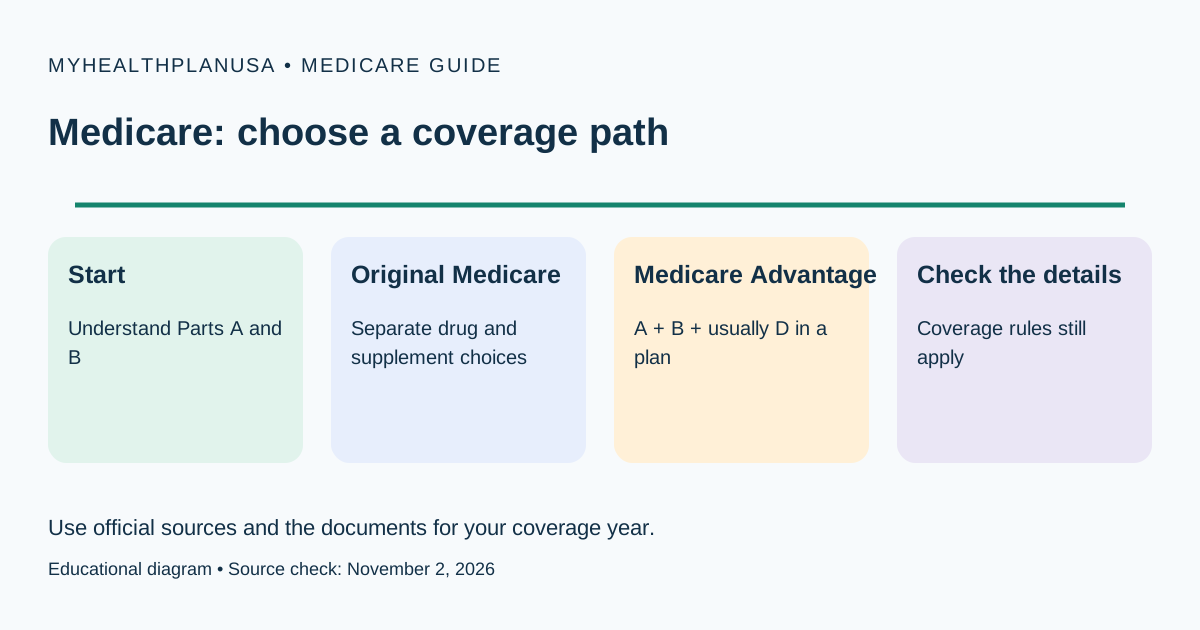
Medicare's letters describe different roles. Part A is hospital insurance, Part B is medical insurance, Part C is Medicare Advantage, and Part D is prescription drug coverage. They are not four levels of quality or four policies that everyone must buy.
Start by learning what each part does, then choose how you want to receive your benefits. Medicare's explanation of how the program works separates enrollment in A and B from the choice between Original Medicare and Medicare Advantage. That sequence helps prevent buying a product before understanding what problem it solves.
A map of the four letters
| Part | Main role | A useful question | Common misunderstanding |
|---|---|---|---|
| A | Hospital insurance | Is this covered inpatient care? | Every service inside a hospital belongs to A |
| B | Medical insurance | What are the coverage and payment rules for this service? | Paying a premium makes every visit free |
| C | Medicare Advantage | How does this private plan deliver my Medicare benefits? | It is the same as a Medigap supplement |
| D | Prescription drug coverage | Does the plan cover my exact medicine? | Every plan covers medicines on identical terms |
Use the table as an orientation tool, not a claim determination. A specific service may require a more detailed answer about setting, medical necessity, or how a medicine is administered. When calling about coverage, name the actual service and ask which benefit applies.
If your first question is whether Medicare is the right program at all, start with Medicare versus Marketplace insurance. The letters in Medicare do not correspond to Marketplace metal levels, and the enrollment processes are different.
Part A: hospital insurance, with conditions
Part A is associated with inpatient hospital care and certain other covered facility or home-care services. It should not be read as a promise that any stay, room, or care arrangement is covered. Medicare's inpatient hospital coverage page explains that inpatient admission requires a doctor's order and a hospital that accepts Medicare. Covered hospital services can include the room, meals, nursing, and supplies, while separate physician services can fall under Part B.
Imagine that Lee goes to the emergency department and stays overnight. The practical question is not how many hours Lee spent in the building. It is whether Lee was admitted as an inpatient or remained an outpatient. Ask the hospital to explain the status in plain language and identify the notice or record showing it.
Keep three questions on your hospital checklist: What is my admission status? Which services will be billed separately? What coverage requirements apply to the next setting if I need care after discharge? Asking early can help you understand a bill before making assumptions about which letter pays it.
Do not confuse premium-free Part A with free hospital care. A premium buys or maintains coverage; a deductible and other service charges concern what you pay when using it. Those are separate parts of a household budget.
Part B: medical and outpatient coverage
Part B covers many medical services and outpatient services. Medicare's outpatient hospital explanation includes emergency or observation care, which may include an overnight stay. It also explains that a hospital outpatient bill may include both provider and hospital charges.
For Lee, this means that the same physical location can involve different billing categories. Asking only whether a hospital accepts Medicare leaves out the care setting and the particular service. When requesting an estimate, ask whether it includes the clinician, facility, laboratory, and other expected charges.
Part B also covers preventive and screening services. Medicare says most covered preventive services cost nothing when the provider accepts assignment. Eligibility, frequency, and the precise service still matter. A preventive visit may involve additional work that has different billing rules, so ask about any separately billed concern or test.
When a term such as coinsurance is unfamiliar, use our deductible, copay, and coinsurance guide. Understanding the vocabulary makes it easier to compare an estimate with the explanation you receive after a claim is processed.
Original Medicare means Parts A and B
Original Medicare includes Part A and Part B. Coverage decisions depend on applicable rules and the service involved; the presence of an A or B card is not universal approval for every item a provider offers.
Think of a coverage check as a small set of questions rather than a yes-or-no label. What exactly is being ordered? Why is it needed? Where will it happen? Is the provider participating in the appropriate way? Are there limits on how frequently the service is covered? Have the estimate and any noncoverage notice been explained?
Write the answers next to the planned service. This is especially useful when several offices are involved. A physician's office may describe the professional service while a hospital estimates only its facility charge. Keeping the pieces together reduces the chance that you mistake one estimate for the entire episode of care.
Part C: a Medicare Advantage coverage path
Medicare Advantage plans are offered by Medicare-approved private companies. They combine A and B benefits and usually Part D. Network arrangements, referral requirements, and prior authorization rules can affect how you get care. You still have Medicare when enrolled in an Advantage plan; Part C is not a way to avoid having Parts A and B.
The decision is therefore more than choosing a familiar insurance logo. Ask how your ongoing care would work under the specific plan. List the clinicians and facilities you use, the places you travel for routine care, and the prescriptions you fill. Request answers about those concrete needs rather than asking whether the plan is generally good.
For a person who needs several specialists, the most useful first comparison may be the path from a primary care visit to testing and specialist treatment. Who makes the referral? Who requests an authorization? Which facility performs the test? Write down the sequence so you can see the practical obligations before enrolling.
Our Medicare Advantage versus Medigap comparison explains the broader choice between an Advantage plan and Original Medicare with supplemental insurance. Medigap is not Part C and is not another Medicare part.
Part D: check the medicine, then the plan
Part D is drug coverage offered through Medicare-approved private plans. Each plan has a formulary, meaning its list of covered drugs. That makes your actual medication list more useful than a general statement that a plan includes prescriptions.
Prepare the exact medicine name, strength, dosage form, refill quantity, and frequency. Two products with similar names may not be the same entry in a comparison tool. Ask the pharmacist or prescriber's office for clarification when your list is unclear rather than guessing from memory.
Then ask the plan how that exact drug is handled, which pharmacy you would use, and whether any coverage requirements apply. Save the information for the plan year you intend to join. An old printout is useful history but not confirmation of next year's terms.
A practical example: Lee finds that two plans both list a prescribed medication. That alone does not finish the comparison. Lee still needs to check the price at an accessible pharmacy and any steps needed before a prescription can be covered. The comparison should preserve the same medication details for each plan.
Keep supplemental insurance and coverage gaps separate
Medigap policies have their own lettered names, which can cause confusion. A Medigap plan letter is not the same thing as a Medicare part. Before comparing two products with similar letters, write their full names and whether each is a Medicare benefit, a drug plan, or supplemental insurance.
Also create a list of needs that do not fit neatly into the four-letter map. Medicare's long-term care guidance explains that nonmedical help with daily living is generally not paid for by Medicare or Medigap. Living in a nursing facility does not itself make every service Medicare-covered skilled care.
That distinction matters when a family is planning support with dressing, bathing, meals, or supervision. Keep the care need separate from the building's name. Ask what service is being provided, what program might pay, and what costs remain the family's responsibility. The label on a brochure cannot answer those questions.
Use the letters to organize your next steps
Make a one-page coverage map with a row for medical coverage, prescriptions, supplemental help, and uncovered needs. Put the responsible program or insurer in each row. Add effective dates and contact details. If two rows appear to cover the same problem, ask how they coordinate rather than assuming both will pay.
Next, place your enrollment dates in the Medicare Enrollment Calendar. Choosing an arrangement and being allowed to enroll in it at a particular time are separate checks. A useful coverage map should show both what you want and what must happen before it becomes active.
Finally, take the map to a Medicare or SHIP counseling conversation. Ask the counselor to identify empty rows, overlapping assumptions, and any action needed before your start date. You do not need to memorize every Medicare rule to make progress; you need a clear record of the questions that affect your own care.
Sources
Frequently asked questions
Is Part C a supplement to Original Medicare?
No. Part C, or Medicare Advantage, is a private-plan way to receive Medicare benefits. Medigap is a different product that supplements Original Medicare.
Does everyone need four separate Medicare policies?
No. A and B are the core parts. Medicare Advantage combines A and B benefits and usually Part D. With Original Medicare, drug and supplemental coverage are separate decisions.
Does an overnight hospital stay always use Part A?
No. Observation care can remain outpatient care even overnight. Ask the hospital whether you have been formally admitted as an inpatient.
Are Medigap Plan D and Medicare Part D the same?
No. Medicare Part D covers prescription drugs through approved plans. Medigap plan letters describe standardized supplemental benefits for Original Medicare; the similar letters do not identify the same coverage.