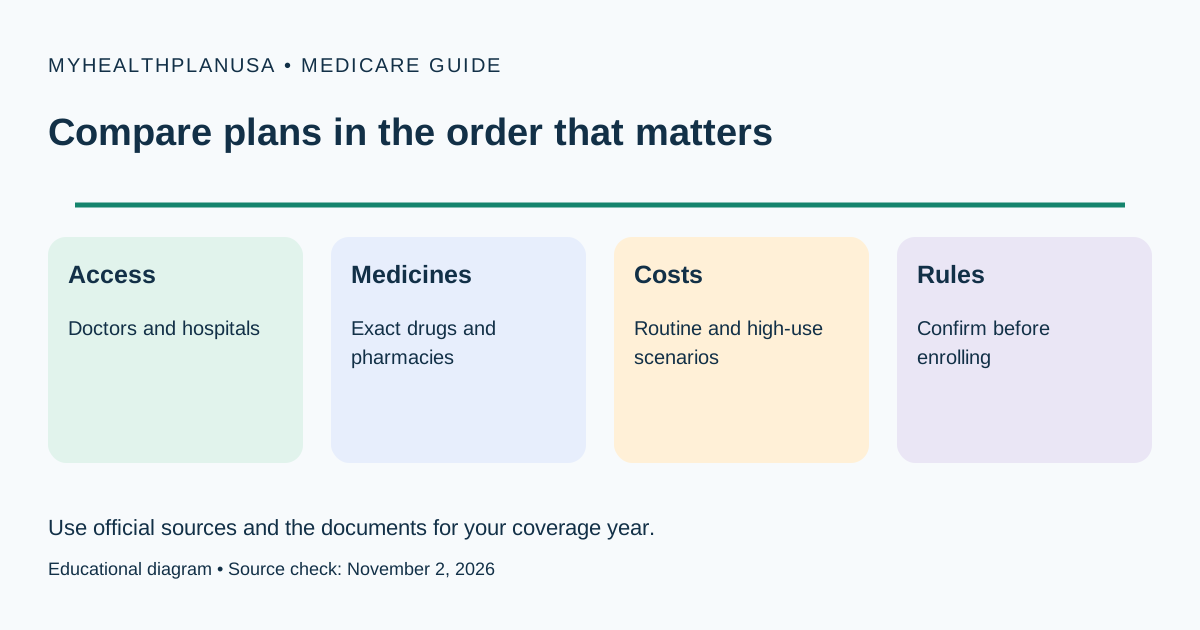
A useful Medicare Advantage comparison starts with the care you need and ends with a documented choice of a specific plan. An insurer's national reputation, a low advertised premium, or a long list of extra benefits does not establish that a particular 2027 plan fits your doctors, medicines, and budget.
Use your location and the correct coverage year throughout the comparison. This guide provides a method, not a national ranking or a quote. No local 2027 plan has been selected for you, and the fictional examples below are not real benefits or prices.
Decide what is essential before viewing offers
Make three lists: requirements, preferences, and questions. A requirement might be access to the hospital treating an ongoing condition. A preference might be a convenient dental office. A question might be how routine care works when you spend part of the year elsewhere.
Write the reason next to each requirement. This prevents an appealing optional benefit from quietly displacing something you originally considered necessary. If cost forces a difficult tradeoff, a written list makes that tradeoff explicit instead of hiding it inside an overall score.
If you are still deciding between Advantage and Original Medicare with supplemental coverage, first read Medicare Advantage versus Medigap. Comparing individual Advantage plans is easier once you understand the coverage arrangement you are evaluating.
Start with local plans and the right year
Medicare's comparison tools can identify plans in your area and estimate drug spending using your prescription list. Record the exact plan name and identifying details, county where relevant, and coverage year. A similarly named plan in another place is not a substitute.
Create one folder or sheet for each serious candidate. Save the 2027 Summary of Benefits, Evidence of Coverage, provider information, and drug information supplied by that plan. If you download a document with a different year on its cover, put it aside until you obtain the correct version.
Begin with a manageable shortlist. Three well-documented options are often more useful than a long list with missing information. If no option meets an essential need, revisit the wider coverage decision with Medicare or an independent counselor instead of choosing the least incomplete comparison.
Check providers at the exact location
For each plan, list your primary care clinician, important specialists, hospital, treatment center, and equipment suppliers. Check the exact practice location and plan. A response that an office accepts the insurer is incomplete when that insurer sells multiple products.
Use both plan information and a conversation with the provider's office. Ask whether the clinician is accepting patients under that particular arrangement and whether your expected services would be delivered at the same location. Keep the date and any reference information with the answer.
Check the route through a whole episode of care. For example, a surgeon, hospital, imaging center, and rehabilitation provider may all matter to the same treatment plan. Confirming only the surgeon leaves important questions open. If a directory and a phone response disagree, ask the plan to resolve the discrepancy before relying on either.
Understand HMO, PPO, and other plan rules
Medicare's plan-type comparison describes important differences. HMOs generally require network care, with exceptions such as emergencies, urgent care, and out-of-area dialysis. PPOs permit out-of-network care but may charge more. Specialist referrals and drug arrangements also differ across plan types.
Use our HMO and PPO terminology guide for the vocabulary, then return to the specific Medicare plan documents. A general plan-type description does not replace the actual contract or establish a particular provider's participation.
Ask which services require prior authorization, who submits the request, and what to do if treatment is already underway when coverage changes. Do not assume that an authorization or referral under your current coverage will automatically settle every requirement under a new plan. Obtain the plan's instructions for the treatment you expect.
Compare drugs using an identical list
Medicare explains that each drug plan has its own formulary. For comparison purposes, write the exact drug name, strength, dosage form, quantity, and frequency. Keep the list consistent across candidates and correct any entry you are unsure about with the prescriber or pharmacist.
For each medicine, record coverage, estimated cost at the pharmacy you would actually use, and any requirements that need clarification. Check practical access as well as price: a cheaper pharmacy that you cannot reach reliably may not solve the problem you are comparing.
If a medicine appears uncovered, do not silently substitute a different medication to improve a plan's estimate. Any treatment alternative is a discussion with your clinician. Keep the coverage question visible until you know whether a clinically appropriate and acceptable option exists.
Estimate total spending, not just the premium
Medicare's coverage comparison explains that the Part B premium continues and a plan premium may also apply. Advantage plans have a yearly limit for covered medical services, potentially with separate in-network and combined limits. That limit is not a ceiling on every dollar you spend on health care.
Use three columns: fixed premiums, medical services, and prescriptions. Put other expenses outside coverage in a fourth column. The guide to out-of-pocket maximums helps distinguish a spending limit from premiums and excluded charges.
Estimate one ordinary year from known needs. Then test a year with substantially more medical use. Ask what happens financially if you need a hospital stay, several specialist appointments, or a period of rehabilitation. You are not predicting illness; you are testing whether the arrangement remains manageable when usage rises.
Use a comparison sheet with evidence
| Item | Candidate A | Candidate B | Evidence or open question |
|---|---|---|---|
| Essential clinician and facility access | Record exact results | Record exact results | Plan and office confirmation |
| Current medications | Same list | Same list | Formulary and pharmacy estimate |
| Annual fixed premiums | Calculate actual quoted amounts | Calculate actual quoted amounts | Correct coverage year |
| Ordinary-year medical and drug costs | Record assumptions | Use identical assumptions | Benefit documents and estimates |
| Higher-use exposure | Record applicable limits and exclusions | Record applicable limits and exclusions | Evidence of Coverage |
| Treatment rules and travel needs | Record practical steps | Record practical steps | Written plan explanation |
The worksheet is an original organizing aid. It does not assign an automatic winner. Our health-plan comparison guide offers additional ways to organize a decision when household members have different insurance needs.
A fictional comparison: protect the essential need
Suppose Dev is comparing two unnamed plans. Candidate A has a lower quoted plan premium and several advertised extras, but Dev has not confirmed access to the infusion center used for ongoing treatment. Candidate B has a higher quoted premium and documented access to that center.
It would be premature to call A the better value. Dev should first resolve the center's participation and the treatment requirements. If A cannot meet an essential care need, optional extras should not compensate for that failure in the comparison score. If both meet the need, then annual cost estimates and preferences can help distinguish them.
Dev should also record uncertainty separately from price. A blank answer is not a zero-dollar charge, and an unconfirmed provider is not a confirmed provider. This simple rule prevents incomplete information from making one candidate look deceptively attractive.
Read extras and ratings in context
For an extra benefit, ask what service is included, which providers may deliver it, what restrictions apply, and what you would pay. If an allowance is advertised, confirm what purchases qualify and whether unused amounts carry forward. The relevant answer is the plan's written terms, not the largest number on an advertisement.
Medicare's yearly review publication points readers to quality and customer-service information alongside coverage and cost comparisons. Use ratings as another input. They do not verify that your doctor participates or that your prescription is covered on acceptable terms.
Before choosing, write a short decision statement: which requirements are met, what you expect to pay, what tradeoffs you accept, and which questions remain. An unresolved essential question is a reason to keep investigating.
Confirm enrollment timing and the handoff
Check Medicare's enrollment-period rules before submitting an application. For the fall annual election selecting 2027 coverage, the window is October 15–December 7, 2026, with changes effective January 1, 2027. Other enrollment opportunities have their own requirements.
Use the Medicare Enrollment Calendar for your submission and follow-up dates. Save the final plan identity, confirmation, and effective date. Tell the relevant offices about the new coverage once it is confirmed, and ask the plan how any ongoing treatment should be coordinated.
Keep your comparison documents through the transition. If a January bill or pharmacy claim does not match expectations, those records give you a clear starting point for asking the plan what happened and what step is needed next.
Sources
Frequently asked questions
Does a zero-dollar plan premium mean Medicare Advantage is free?
No. The Part B premium generally continues, and service cost sharing, prescriptions, and uncovered expenses can still apply. Compare total costs rather than the advertised plan premium alone.
Is a PPO always better than an HMO?
No. The right fit depends on the actual network, out-of-network terms, costs, and care needs. The plan type is a starting point for questions, not a quality ranking.
Can I compare plans without listing my medicines?
You can view general information, but a drug-cost comparison will not be tailored to your needs without accurate medication and pharmacy details.
Should I choose the plan with the most extra benefits?
Only after checking essential medical access, drug coverage, and financial risk. An extra benefit has limited practical value if its conditions or provider arrangements make it unusable for you.